Resistance Band Exercises for Seniors (With Pictures)
These resistance band exercises for seniors need one flat band, about 5 feet long, and a sturdy chair. All eight moves here are done seated. You will press, pull, row and push with your legs, working the chest, upper back, arms, hips and thighs in about 15 minutes.
A band gives smooth, adjustable resistance that is gentle on the joints. To make any move harder, hold the band shorter. To make it easier, hold it longer. A light or medium band suits most people at the start, and it folds into a drawer when you are done.
2-page PDF, large print, US Letter. Use the Men / Women switch at the top to change the photos.
Who these moves are for
This routine suits adults over 60, 70 and 80 who want a strength workout without weights. It works well for beginners, for people who prefer to exercise seated, and for travelers who want something that fits in a suitcase. If you can sit tall in a chair and hold the band firmly, you have everything you need to start today.
The 8 moves
-
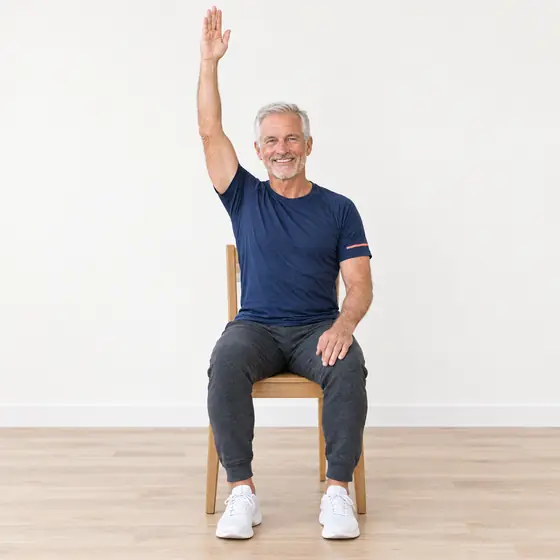
Overhead Reach
Warms the shoulders and sides for reaching up to a closet shelf or pulling on a sweater.
- Sit tall, feet flat, no band.
- Reach one arm up toward the ceiling.
- Lower it and reach with the other arm.
- Easier
- Reach to shoulder height.
- Harder
- Reach a little higher and slower.
- Coach tip
- Grow tall through the top of your head.
- Week 1
- 8 reps
-
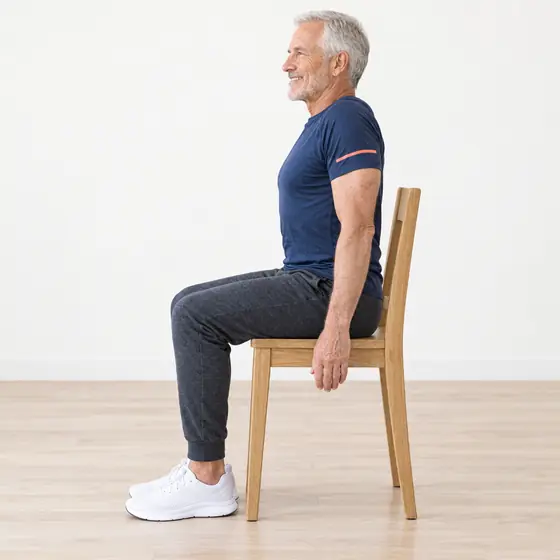
Shoulder Rolls
Loosens the neck and upper shoulders so the pulling moves that follow feel smooth and easy.
- Sit tall, arms relaxed.
- Roll your shoulders up, back and down.
- Make slow, smooth circles.
- Easier
- Roll one shoulder at a time.
- Harder
- Make the circles bigger.
- Coach tip
- Breathe out as your shoulders drop.
- Week 1
- 8 reps
-
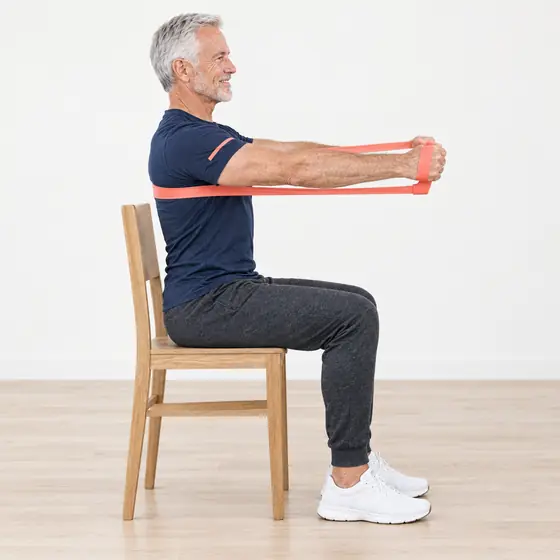
Band Chest Press
Builds the chest and arms you use to push open a door or push yourself up from an armchair.
- Sit tall, band around your upper back, an end in each hand at chest height.
- Press both hands straight forward.
- Return slowly.
- Easier
- Hold the band longer.
- Harder
- Hold the band shorter.
- Coach tip
- Don't let your back leave the chair.
- Week 1
- 8 reps
-
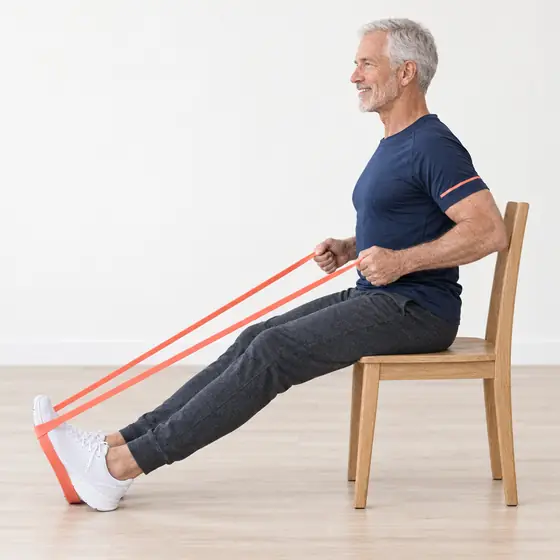
Band Seated Row
Strengthens the upper back for sitting and standing tall, and for pulling open a heavy drawer or car door.
- Sit tall, legs out, band around the soles of your feet.
- Hold an end in each hand, arms straight.
- Pull your elbows back, squeezing your shoulder blades, then return.
- Easier
- Bend your knees a little.
- Harder
- Hold the band shorter.
- Coach tip
- Sit up tall as you pull.
- Week 1
- 8 reps
-
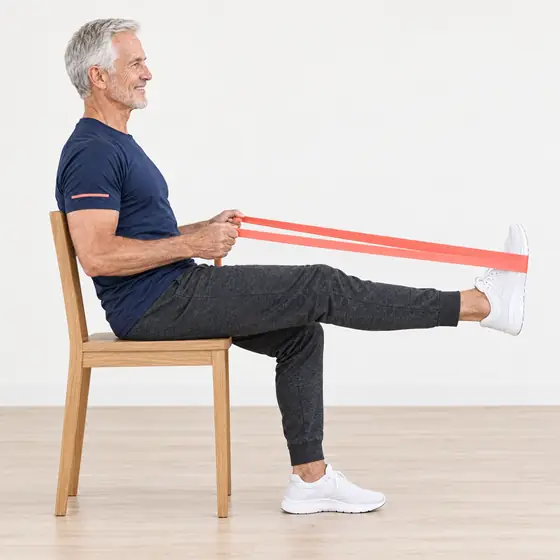
Band Leg Press
Works the thighs and glutes in a seated position, building the push you need to climb stairs.
- Sit tall, band around one foot, an end in each hand.
- Bend that knee toward your chest.
- Press the foot forward until the leg is straight, then switch.
- Easier
- Press only part way.
- Harder
- Hold the band shorter.
- Coach tip
- Push through your heel.
- Week 1
- 8 reps
-
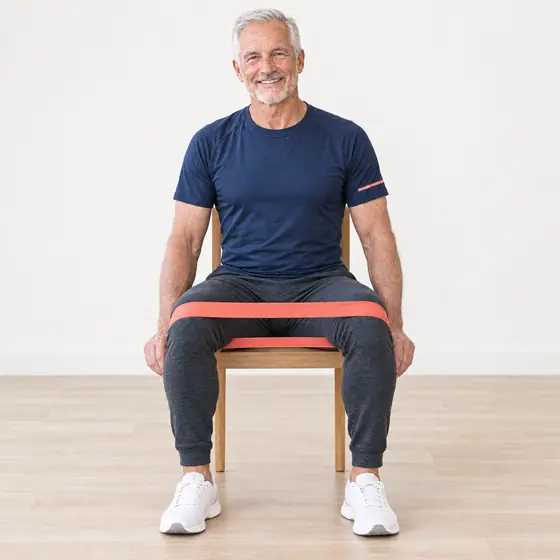
Band Knee Press-Out
Strengthens the outer hips, which help keep you steady when you walk, turn and step sideways.
- Sit tall, band tied in a loop just above your knees.
- Press your knees apart.
- Bring them back together slowly.
- Easier
- Use a lighter band.
- Harder
- Pause 2 seconds with knees apart.
- Coach tip
- Keep your feet flat on the floor.
- Week 1
- 8 reps
-
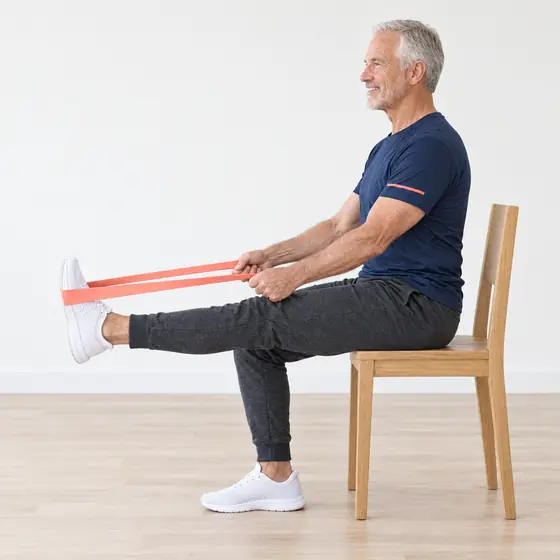
Band Hamstring Stretch
Uses the band to lengthen the back of the thigh gently, without folding forward over your legs.
- Sit tall, band looped around one foot.
- Straighten that leg forward, heel down or slightly lifted.
- Gently pull the band until you feel a stretch, then switch.
- Easier
- Keep a small bend in the knee.
- Harder
- Lift the leg a little higher.
- Coach tip
- Keep your back long.
- Week 1
- hold 15 seconds
-
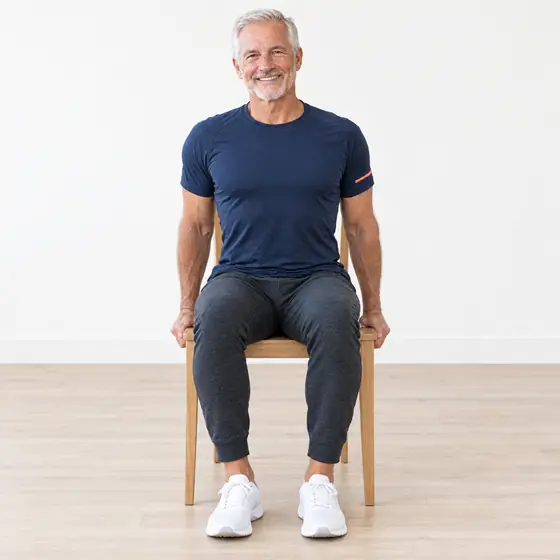
Seated Chest Stretch
Opens the chest and front of the shoulders after pressing, making it easier to sit up straight.
- Sit tall near the front of the chair.
- Reach both hands behind you and hold the sides of the seat.
- Lift your chest and hold.
- Easier
- Lift only a little.
- Harder
- Hold for a few breaths longer.
- Coach tip
- Opens up all the pressing work.
- Week 1
- hold 15 seconds
A simple routine to start
For week 1, set aside about 15 minutes, 3 days a week. Go through the eight moves once. Do 8 slow reps of each band move, letting the band return under control, and hold each stretch for 15 seconds. The Leg Press and Hamstring Stretch are done on each side. Choose a band tension that lets you finish all 8 reps smoothly.
How to progress over 4 weeks
- Week 2: add a fourth day, do 10 reps of each move and hold stretches for 20 seconds.
- Week 3: keep 4 days and 10 reps, and run through the eight moves two times.
- Week 4: work out 5 days, 2 rounds of 12 reps with 30-second holds. Hold the band a little shorter if 12 feels easy.
Stay safe and comfortable
- Check the band for nicks or tears before each session, and replace it if you find any.
- Keep the band away from your face, and let it return slowly instead of letting it snap back.
- Hold the ends with a firm grip, or wrap them once around your hand, so the band can't slip off your feet.
- Sit near the front of a sturdy chair with no wheels, with both feet flat on the floor.
Resistance band exercises for seniors over 70 and over 80
Resistance band exercises for seniors over 70 or over 80 work well with the lightest band and the easier options. Hold the band longer for less tension, press only part way on the Leg Press, and bend the knees a little during the Seated Row. Since all eight moves here are done seated, you can build strength without standing at all, then add the plan's standing moves later.
Questions
What are the best resistance band exercises for seniors' legs?
The Band Leg Press and Band Knee Press-Out are two of the most useful. The leg press works the thighs and glutes you use for stairs and getting up, and the press-out strengthens the outer hips for steady walking. Both are done seated, so they are easy to start with.
What color resistance band should a senior start with?
Colors vary by brand, so check the label for the resistance level rather than the color. Most people start with a light or medium flat band. You should be able to finish 8 to 12 smooth reps with good form. If the last few reps feel too easy, move up to the next level.
Are resistance bands as good as weights for older adults?
Bands can build strength very well and have some advantages. They are light, low cost, easy to adjust and gentle on the joints, because the resistance builds smoothly through each move. Weights are easier to measure. Many people use both, but a band alone is enough for a complete beginner routine.
Is there a free printable resistance band workout for seniors?
Yes. This page is free and prints cleanly, with all eight moves and their photos. For the complete routine, the 28-Day Band Workout is a large-print PDF with 16 moves, a four-week schedule, a tracker, a band curl test and a wall poster.
Can I use resistance bands with arthritis or after surgery?
Bands are often a comfortable choice because you control the tension. Start with the lightest band and keep each move in a range that feels easy on the joints. If you have arthritis, a joint replacement or a recent operation, check with your doctor or physical therapist first.