Walking Plan for Seniors (With Pictures)
This walking plan for seniors pairs a short daily walk with 8 simple moves that make each step stronger. Before you head out, you march in place and rock heel to toe. Then you work your legs and stride with sit to stands, calf raises and side steps, and finish with two stretches.
In week one, the moves take about 10 minutes and the walk is 10 minutes, so a full session fits in under half an hour. You need comfortable walking shoes, a sturdy chair to hold, and a safe route: a neighborhood loop, a mall, a park path or a hallway at home.
2-page PDF, large print, US Letter. Use the Men / Women switch at the top to change the photos.
Who these moves are for
This plan fits adults over 60, 70 and 80 who already walk a little and want more confidence and distance. It works for beginners starting with short walks, for people getting back on their feet after a slower season, and for anyone who wants a clear weekly schedule instead of guessing how far to go.
The 8 moves
-
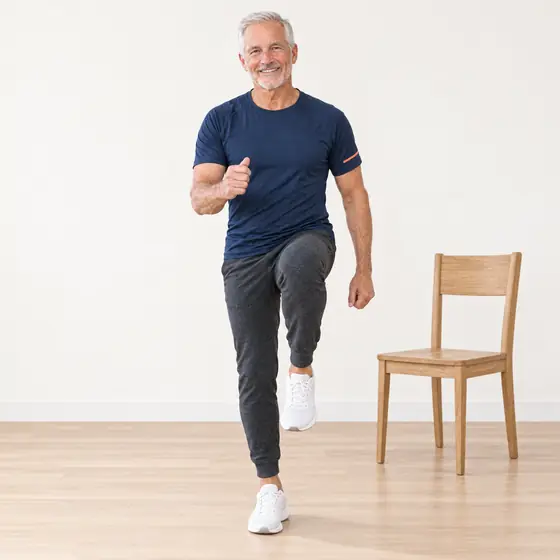
March in Place
Raises your heart rate and warms the hips before a walk, so the first few blocks feel smoother.
- Stand tall, one hand on the chair back if you like.
- Lift one knee, then the other, swinging your arms.
- Keep a steady rhythm and breathe.
- Easier
- Lift your knees only a little.
- Harder
- Lift your knees higher and pump your arms.
- Coach tip
- Stand tall like a string pulls you up.
- Week 1
- hold 15 seconds
-
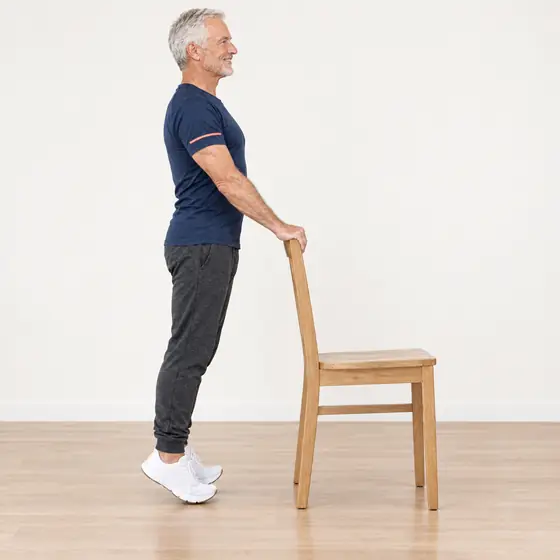
Heel-Toe Rocks
Wakes up the shins and calves that lift your toes, helping your feet clear uneven sidewalks and door sills.
- Hold the chair back, feet hip-width apart.
- Rock up onto your toes.
- Rock back onto your heels, lifting your toes.
- Easier
- Make the rock smaller.
- Harder
- Let go of the chair.
- Coach tip
- Go slow and smooth, like a rocking chair.
- Week 1
- 8 reps
-
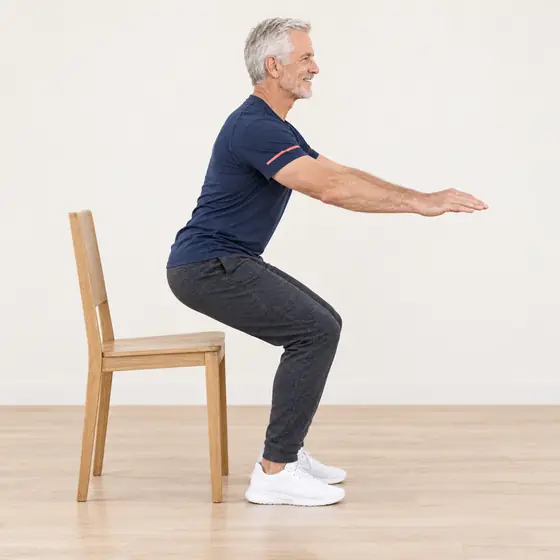
Sit to Stand
Strengthens the thighs and glutes that power every step and help you rise from a bench at the park.
- Sit near the front of the chair, feet flat.
- Lean forward and stand up, pushing through your heels.
- Sit back down slowly.
- Easier
- Use your hands on your thighs to help.
- Harder
- Cross your arms over your chest.
- Coach tip
- Nose over toes as you stand.
- Week 1
- 8 reps
-
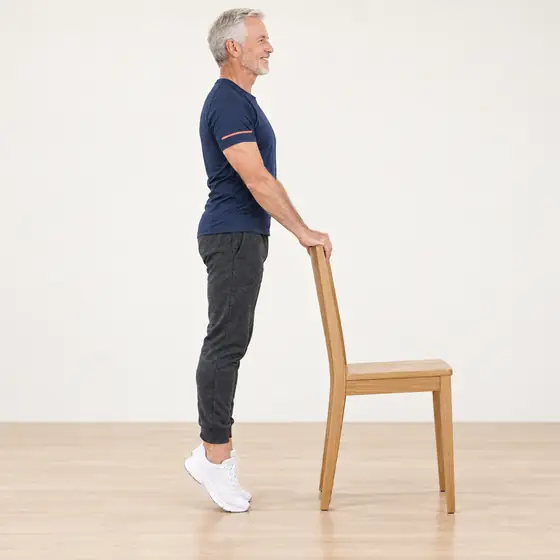
Calf Raises
Builds calf strength for the push-off at the end of each step, which adds pace without extra effort.
- Hold the chair back, feet hip-width apart.
- Rise up onto your toes as high as you can.
- Lower your heels slowly.
- Easier
- Rise up only halfway.
- Harder
- Pause at the top for 2 seconds.
- Coach tip
- Strong calves push you forward when you walk.
- Week 1
- 8 reps
-
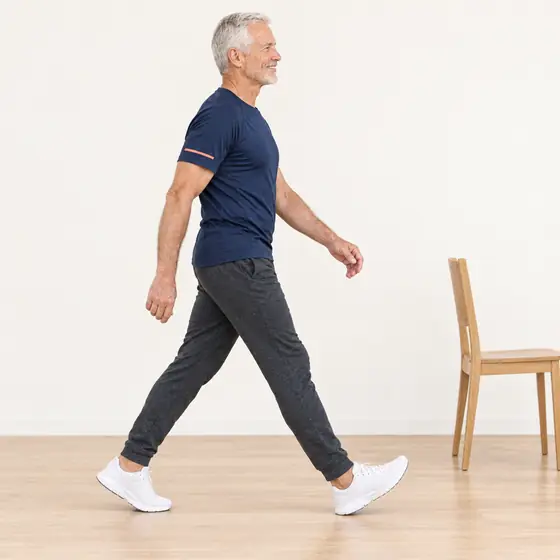
Heel-to-Toe Steps
Grooves a heel-first landing and toe push-off, the pattern behind a smooth, even walking stride.
- Take a step forward.
- Land on your heel first.
- Roll through to push off from your toes.
- Easier
- Take shorter steps.
- Harder
- Take slightly longer steps with a stronger push.
- Coach tip
- Heel, roll, toe: the natural walking step.
- Week 1
- 8 reps
-
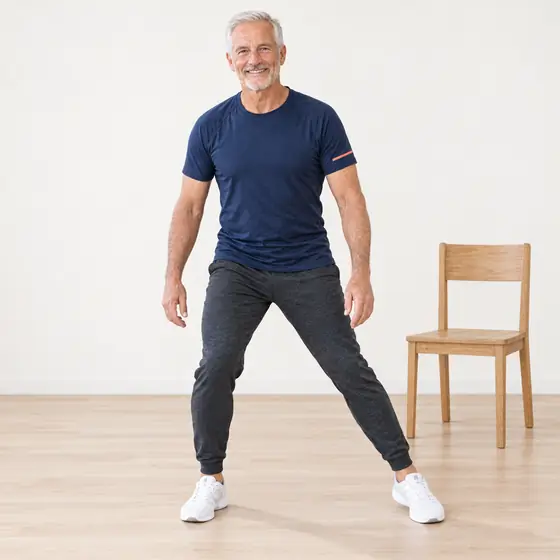
Side Steps
Works the side hips that keep you steady when you step around a puddle or move through a crowded store.
- Stand tall, feet together.
- Step to the side, then bring the other foot to meet it.
- Take steps one way, then come back.
- Easier
- Hold a counter as you move.
- Harder
- Bend your knees slightly as you step.
- Coach tip
- Keep your toes pointing forward.
- Week 1
- 8 reps
-
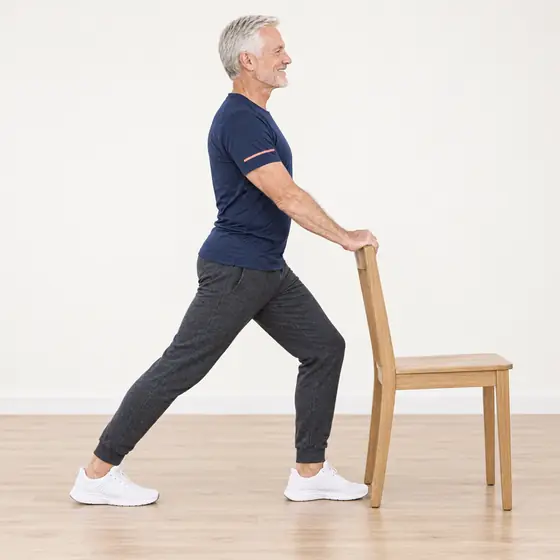
Calf Stretch
Releases the calves after a walk, which can ease that tight feeling the next morning.
- Hold the chair back, step one foot back.
- Keep the back leg straight, heel down.
- Bend the front knee until you feel a stretch, then switch.
- Easier
- Take a smaller step back.
- Harder
- Step a little further back.
- Coach tip
- Both toes point forward.
- Week 1
- hold 15 seconds
-
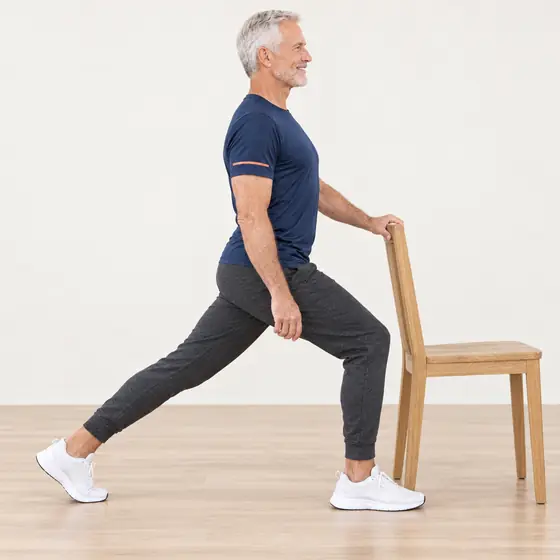
Hip Flexor Stretch
Opens the front of the hips after sitting, so your back leg can reach further with each stride.
- Hold the chair back and take a big step forward.
- Keep your back heel lifted and back leg long.
- Gently shift your hips forward, then switch.
- Easier
- Take a shorter step.
- Harder
- Raise the arm on the back-leg side overhead.
- Coach tip
- Tuck your tailbone under slightly.
- Week 1
- hold 15 seconds
A simple routine to start
Three days a week, do the 8 moves once in order, then walk. March in place for 30 seconds. Do 8 reps of each rep move, 8 per side where it switches. Hold each stretch for 15 seconds per side. Then walk for 10 minutes at a pace where you can still talk, and save the two stretches for after.
How to progress over 4 weeks
- Week 2: walk 4 days for 15 minutes, raise the reps to 10, hold stretches for 20 seconds and march for 40 seconds.
- Week 3: keep 4 days, 10 reps and 20-second holds, and stretch the walk to 20 minutes.
- Week 4: walk 5 days for 25 minutes, do 12 reps, march for 60 seconds and hold stretches for 30 seconds.
Stay safe and comfortable
- Wear walking shoes with a firm heel and a grippy sole, and tie them snugly before you start.
- For the standing moves, hold the back of a sturdy chair or a kitchen counter.
- Walk at a pace where you can still hold a conversation, and carry water on warm days.
- If you have a heart, lung or joint condition, ask your doctor or physical therapist how far and how fast to walk.
Walking plan for seniors over 70 and over 80
For a walking workout over 70 or over 80, start with the easier options and shorter walks. Lift your knees only a little when you march, use your hands on your thighs for sit to stand, and hold a counter during side steps. Keep the first walks to 5 or 10 minutes, indoors if you like, and add 5 minutes per week only when the last week felt comfortable.
Questions
What is a good walking schedule for seniors?
A good starting schedule is 3 days a week for 10 minutes, with a rest day between walks. Add about 5 minutes and one extra day every week or two. By week four of this plan, that reaches 5 days and 25 minutes, which is a comfortable, steady routine for most people.
Can seniors lose weight with a walking plan?
Walking can help, because it burns energy and you can do it almost every day. The strength moves add muscle, which supports the body you want over time. Most weight change comes from regular walks combined with steady eating habits, so think of this plan as one strong piece of that.
How do I do a walking routine at home?
You can do the full routine indoors. Do the 8 moves next to a sturdy chair, then walk laps through your hallway, kitchen and living room, or march in place during a TV show. Clear rugs and cords from your path first, and count minutes rather than distance.
Is there a walking program for seniors as a PDF?
You can print this page as a free one-page version of the plan with the 8 moves and week-by-week numbers. The full 28-day plan is a printable PDF with all 16 moves, a 4-week calendar, a walk tracker and a wall poster in large print.
How far should a senior walk each day?
Time is a better guide than distance. Start with 10 minutes at a pace where you can still talk, then build toward 20 to 30 minutes over a few weeks. Your distance will grow on its own as your legs and stride get stronger.